Cerebral Palsy
Rehabilitation in Patna, Bihar
Cerebral palsy encompasses neurological conditions that may influence movement, muscle coordination, posture, balance, and everyday physical function. The way it presents can vary widely. Some children may have difficulty sitting, standing, walking, reaching, or using their hands, while others may experience stiffness, involuntary movements, weakness, or problems with balance and coordination. These difficulties can also influence activities such as dressing, eating, playing, communicating, or participating at school.
Cerebral Palsy Rehabilitation in Patna focuses on helping individuals develop and maintain functional abilities according to their age, physical capacity, movement pattern, and personal goals. Depending on the individual’s needs, cerebral palsy physiotherapy may include mobility work, stretching, strengthening, gait training, balance activities, posture practice, and task-specific exercises.
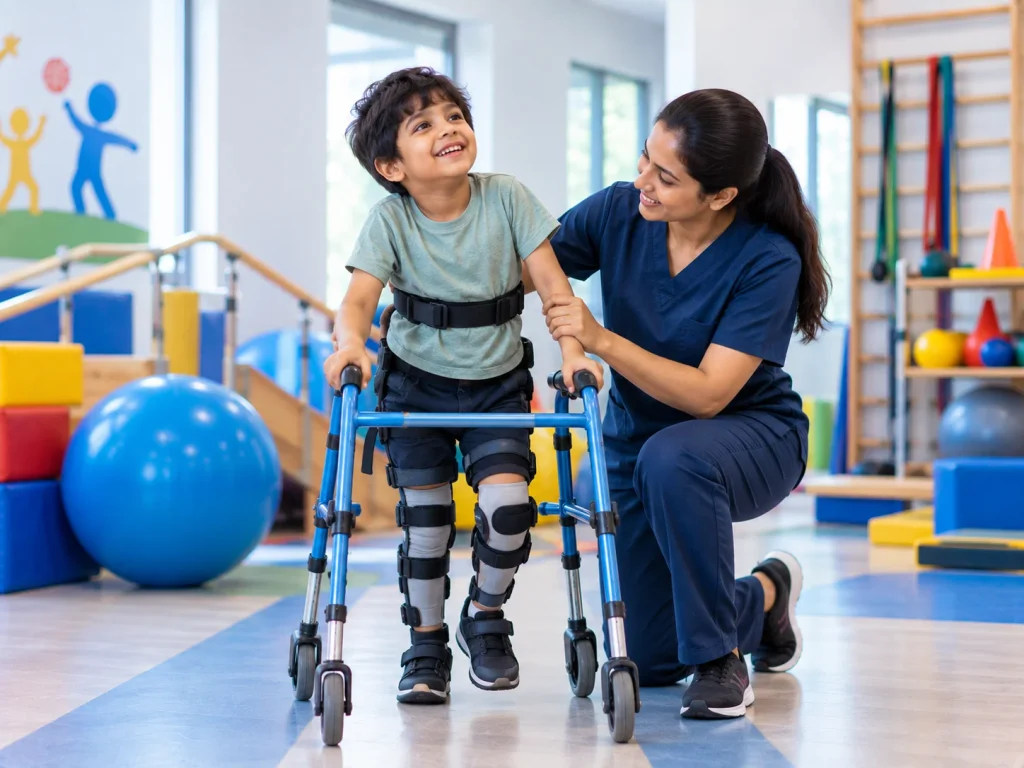
Understanding Cerebral Palsy Rehabilitation and How Mission Walk & Run Supports Recovery
Common Symptoms and Problems Associated With Cerebral Palsy
Cerebral palsy can affect different parts of the body and may have varying effects on movement and function. Some individuals have relatively mild movement difficulties, while others require substantial assistance for mobility and daily activities. As a child develops, these difficulties may evolve with changes in physical demands, body growth, muscle flexibility, and functional needs.
Common movement and functional difficulties can include:
- Muscle stiffness or increased muscle tone
- Weakness or reduced voluntary muscle control
- Involuntary or uncontrolled movements
- Delayed development of motor skills
- Difficulty maintaining posture
- Problems with balance and coordination
- Challenges with standing, walking, or changing positions
- Difficulty using the hands for precise activities
- Changes in walking pattern
- Reduced flexibility or joint movement
These difficulties can affect participation at home, school, work, or within the community. Rehabilitation therefore considers not only individual symptoms but also how those symptoms influence practical activities and independence.
Symptoms and Problems Associated With Cerebral Palsy Rehabilitation
Cerebral palsy can influence physical function in different ways, and the challenges may vary depending on the type and extent of motor involvement. Some individuals may experience difficulty controlling movements, maintaining posture, changing positions, or performing activities that require coordinated use of the arms and legs.
Common difficulties may include:
- Muscle stiffness or unusual muscle tone
- Reduced muscle strength or control
- Limited joint movement or flexibility
- Difficulty maintaining sitting or standing positions
- Problems with balance and coordination
- Challenges with walking or changing direction
- Difficulty with transfers and functional movements
- Reduced hand and arm control
- Altered walking or movement patterns
- Greater effort required for everyday activities
As children grow, their physical requirements can change. Differences in body size, muscle flexibility, strength, mobility, and activity demands may create new functional challenges. For this reason, rehabilitation needs may also change over time and should be reviewed according to the person’s current abilities and daily requirements.
Who Can Benefit From Cerebral Palsy Rehabilitation?
Cerebral palsy rehabilitation may benefit children, adolescents, and adults experiencing movement or physical limitations associated with the condition. Rehabilitation goals differ from person to person. For a young child, therapy may concentrate on developing foundational movement abilities, while an older individual may need support with mobility, strength, balance, coordination, or maintaining independence.
A rehabilitation programme may be considered for individuals experiencing:
- Difficulty sitting, standing, or walking
- Muscle tightness affecting movement
- Balance or coordination difficulties
- Reduced upper- or lower-limb strength
- Challenges with transfers and mobility
- Difficulty performing age-appropriate activities
- Changes in walking ability as the person grows
- Reduced physical activity or endurance
An early and appropriate assessment can help identify functional limitations and establish practical goals. Rehabilitation can also remain relevant throughout life because physical requirements may change with growth, ageing, activity levels, or changes in musculoskeletal function.
Who Can Benefit From Cervical & Neck Pain Physiotherapy?
Cervical and neck pain physiotherapy may be suitable for people experiencing recurring neck discomfort, stiffness, reduced cervical mobility, posture-related problems, muscle tightness, or movement difficulties.
It may also be useful for:
- Office and computer users
- People with prolonged sitting habits
- Individuals experiencing neck and shoulder stiffness
- Patients recovering from certain neck injuries
- People with reduced neck flexibility
- Individuals whose neck discomfort affects everyday activities
Patients with severe, sudden, or unusual symptoms should seek appropriate medical evaluation rather than relying only on self-directed exercises.
Patient Testimonials
See how Mission Walk and Run has made a difference in the lives of our patients
EXCELLENT Based on 9 reviews
 Posted on Google

 Varsha SharmaI had a very good experience at this physiotherapy clinic. The therapist is professional, knowledgeable, and very supportive. They explained the problem clearly and guided me through the exercises and treatment properly. The clinic is clean, well-maintained, and has a positive environment. I would definitely recommend this clinic to anyone looking for effective and professional physiotherapy treatment.Posted on Google
 ranjana kumariI got relief in my knee pain.Posted on Google
 Baliraj SinghGreat 👍 Great work Advance technology used for exercise, Got relief from painPosted on Google
 Mani Bhushanघुटनों के दर्द में बहुत आराम मिला। वहाँ के लोग अच्छी सर्विस दिए।Posted on Google
 reena singhBest physiotherapist in this centre got relief in Frozen shoulderPosted on Google
 Abhijeet KumarBest rehabilitation centre in patnaPosted on Google
 Reetu singh Rajput“It was my first visit to physiotherapy. The physiotherapist listened to my problem patiently and explained the exercises properly. The staff was polite and helpful. Overall, it was a good experience.”Posted on Google
 Ranjan YadavGood 👍🏻Posted on Google
 Pradeep VashisthaBest physiotherapy centre in Patna I got relief in my neck pain thanks to mission walk & run team👍👍
Expert Physiotherapy Care for Cerebral Palsy Recovery
There is no single cerebral palsy best treatment that is suitable for every individual. Management may involve physiotherapy together with appropriate medical, developmental, occupational, speech and language, orthotic, educational, or psychological support, depending on the person’s requirements.
The rehabilitation approach may include:
- Mobility and flexibility work
- Progressive strengthening
- Balance and postural control
- Walking and gait practice
- Transfer and functional movement training
- Coordination activities
- Task-specific movement practice
The aim is not simply to complete a set number of exercises. Therapy should relate to meaningful activities and be modified according to the person’s response, abilities, and changing needs.
Physiotherapy Evaluation for Cerebral Palsy
A detailed assessment provides an important foundation for an appropriate rehabilitation plan. During cerebral palsy physiotherapy, the therapist may evaluate movement quality, muscle strength, flexibility, posture, balance, coordination, walking ability, transfers, and functional activities.
The assessment may help identify:
- Current functional abilities
- Areas of weakness or restricted movement
- Balance and postural control
- Walking and mobility limitations
- Transfer difficulties
- Upper-limb and hand function
- Activities requiring additional assistance
- Individual rehabilitation priorities
This information helps establish an appropriate programme based on the person’s present abilities instead of applying a standard exercise routine.
Why Choose Mission Walk & Run for Cerebral Palsy Rehabilitation in Patna, Bihar ?
Cerebral palsy can affect each patient differently, so rehabilitation needs to reflect their specific movement and functional challenges. Therapy is planned around individual abilities, mobility, posture, strength, coordination, and everyday activity requirements.
Personalised Movement & Functional Assessment
Each patient is assessed to understand movement capacity, physical limitations, mobility needs, postural control, strength, coordination, and difficulties with daily activities.
Individualised Rehabilitation Planning
The rehabilitation plan is developed according to the patient’s age, abilities, physical requirements, and functional goals, with adjustments made as their needs change.
Guided Mobility & Movement Training
Patients receive professional guidance through appropriate mobility exercises, movement practice, strengthening, balance activities, and functional training based on their abilities.
Functional Development & Independence Support
Rehabilitation focuses on practical skills that may support mobility, coordination, strength, endurance, and greater participation in everyday activities.
Ready to take the next step?
Book your physiotherapy session today and start your session journey towards a pain-relief life
Personalised Cerebral Palsy Rehabilitation at Mission Walk & Run
Physiotherapy Evaluation for Cerebral Palsy Rehabilitation
A detailed assessment provides an important foundation for an appropriate rehabilitation plan. During cerebral palsy physiotherapy, the therapist may evaluate movement quality, muscle strength, flexibility, posture, balance, coordination, walking ability, transfers, and functional activities.
For children, the evaluation may also consider developmental abilities and current functional skills. For adolescents and adults, assessment may place greater emphasis on maintaining mobility, managing physical limitations, improving activity tolerance, and supporting independence.
The assessment may help identify:
- Current functional abilities
- Areas of weakness or restricted movement
- Balance and postural control
- Walking and mobility limitations
- Transfer difficulties
- Upper-limb and hand function
- Activities requiring additional assistance
- Individual rehabilitation priorities
This information helps establish an appropriate programme based on the person’s present abilities instead of applying a standard exercise routine.
Physiotherapy-Based Cerebral Palsy Rehabilitation Management
Cerebral palsy rehabilitation therapy is generally progressive. Exercise difficulty can be modified as the person’s physical abilities, tolerance, and functional requirements change. For example, someone working toward improved standing may initially practise supported weight-bearing and postural control before progressing to more demanding standing and movement tasks.
Cerebral palsy and physical therapy may address several connected areas rather than focusing on walking or muscle tightness alone. A person experiencing walking difficulty may also require attention to strength, flexibility, balance, weight shifting, posture, and coordination.
Cerebral palsy gait training may be appropriate for individuals who are able to walk or are working toward improved walking skills. Depending on the person’s abilities, practice may involve stepping, weight transfer, foot placement, balance, turning, and movement control. The goal is to work toward functional and safe mobility rather than promise a particular walking outcome.
Cerebral palsy balance training may involve controlled weight shifting, reaching, supported standing, changes in position, and functional movement activities. The level of challenge should be appropriate to the individual’s current postural control and safety requirements.
Cerebral palsy stretching exercises may be included when reduced flexibility or muscle tightness affects movement.
Benefits of Parkinson’s Rehabilitation Treatment
Cerebral palsy rehabilitation may benefit children, adolescents, and adults experiencing movement or physical limitations associated with the condition. Rehabilitation goals differ from person to person. For a young child, therapy may concentrate on developing foundational movement abilities, while an older individual may need support with mobility, strength, balance, coordination, or maintaining independence.
A rehabilitation programme may be considered for individuals experiencing:
- Difficulty sitting, standing, or walking
- Muscle tightness affecting movement
- Balance or coordination difficulties
- Reduced upper- or lower-limb strength
- Challenges with transfers and mobility
- Difficulty performing age-appropriate activities
- Changes in walking ability as the person grows
- Reduced physical activity or endurance
An early and appropriate assessment can help identify functional limitations and establish practical goals. Rehabilitation can also remain relevant throughout life because physical requirements may change with growth, ageing, activity levels, or changes in musculoskeletal function.
FAQs About Cerebral Palsy Rehabilitation
Exercise selection depends on the child’s movement abilities, physical condition, age, and rehabilitation goals. A programme may include activities addressing mobility, flexibility, strength, balance, posture, coordination, walking, and functional skills. Exercises should be selected after assessment rather than copied from a general exercise list.
Physiotherapy can work on physical skills that contribute to walking, including strength, balance, postural control, weight shifting, coordination, and stepping practice. However, walking ability varies considerably among children with cerebral palsy. The outcome depends on several factors, including the person’s motor impairment and functional abilities, so independent walking cannot be guaranteed.
Physiotherapy can use structured activities involving posture, reaching, weight shifting, standing, stepping, and controlled movement. Repeated functional practice can help individuals work on balance and coordination. The difficulty of these activities should be adjusted according to the person’s current abilities and safety requirements.
Cerebral palsy rehabilitation may involve physiotherapy, occupational therapy, speech and language therapy, orthotic management, assistive technology, and medical care when appropriate. The combination depends on the individual’s symptoms and functional needs. Physiotherapy commonly addresses areas such as mobility, strength, flexibility, balance, gait, posture, and functional movement.
Rehabilitation can support independence by working on physical and functional skills required for everyday tasks. Depending on the individual’s abilities, therapy may address sitting, standing, transfers, walking, reaching, hand use, or alternative ways of completing activities. The objective is to improve practical function according to the person’s capabilities.