Parkinson’s
Rehabilitation in Patna, Bihar
Parkinson’s disease can gradually influence walking, posture, balance, coordination, and the ability to manage everyday movements. Individuals may experience slower actions, stiffness, tremors, smaller steps, difficulty changing direction, or reduced stability. Non-movement concerns such as tiredness, sleep disturbances, mood changes, and cognitive difficulties may also occur.
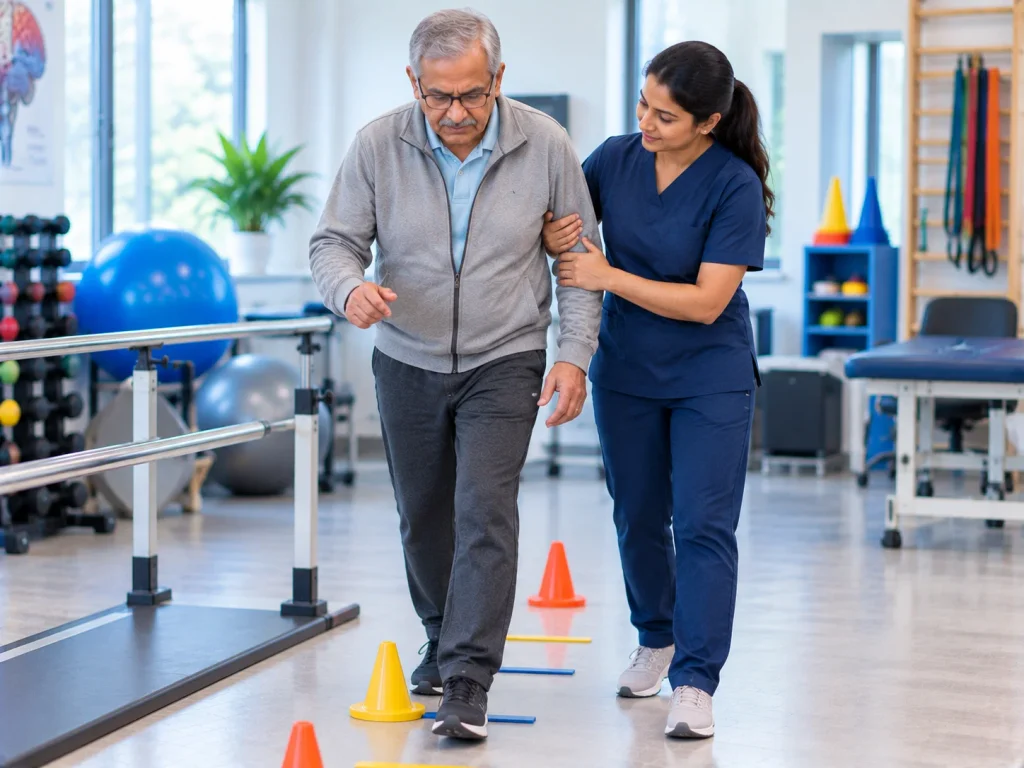
Parkinson’s Rehabilitation in Patna aims to support functional movement, mobility, and physical independence through personalised physiotherapy. At Mission Walk & Run, Physio Ortho Neuro Rehab Centre in Rajeev Nagar, Patna, therapy is planned around each patient’s walking ability, balance, strength, coordination, movement control, and daily requirements. Sessions may involve gait practice, mobility training, balance work, strengthening, posture exercises, flexibility, and functional activities. Dr. Manish Kumar, with 6 years of experience and 10,000+ patients treated, supports an individualised approach in which exercises are adjusted according to the patient’s abilities and response to rehabilitation.
Understanding Parkinson’s Rehabilitation and How Mission Walk & Run Supports Recovery
Common Movement and Functional Difficulties in Parkinson’s Disease
Parkinson’s disease can affect people differently, with symptoms and functional limitations varying in severity. Over time, difficulties may arise with walking, standing from a chair, turning, reaching, or maintaining balance.
The recognised Parkinson’s disease cardinal symptoms include resting tremor, bradykinesia (slowness of movement), rigidity, and postural instability. Not every person develops all of these features, and symptoms may change as the condition progresses.
Movement-related difficulties may include:
- Slower everyday movements
- Muscle stiffness
- Resting tremor
- Postural changes
- Shorter or slower steps
- Difficulty initiating walking
- Problems turning or changing direction
- Reduced balance
Non-motor concerns may also occur, including anxiety, depression, cognitive changes, sleep disturbances, and fatigue. Since symptoms can fluctuate, rehabilitation should consider the patient’s routine, medication timing, energy levels, and functional needs.
Symptoms and Problems Associated With Parkinson’s Disease
Parkinson’s disease may gradually change the way a person moves and handles routine physical tasks. The difficulties are not identical for everyone and can vary as the condition progresses, sometimes making familiar activities require more effort or concentration.
Some commonly observed movement challenges include:
- Slower execution of everyday movements
- Tightness or reduced flexibility in muscles
- Trembling while the body is relaxed
- Altered standing or walking posture
- Shorter steps or reduced walking speed
- Difficulty getting a movement started
- Trouble turning, stopping, or changing direction
- Reduced steadiness while standing or walking
- Difficulty rising from a chair or bed
- Reduced coordination during practical tasks
Parkinson’s disease can also be accompanied by non-motor concerns, including tiredness, disturbed sleep, anxiety, low mood, and changes in cognitive function. These issues may influence a person’s activity levels and ability to participate consistently in rehabilitation. Because symptoms can vary throughout the day, rehabilitation planning should take into account the individual’s daily routine, medication schedule, energy levels, and functional requirements.
Who Can Benefit From Parkinson’s Rehabilitation?
Parkinson disease rehabilitation may benefit people who are experiencing movement limitations or difficulty maintaining their usual level of physical function. Physiotherapy does not cure Parkinson’s disease, but it can address specific physical and functional challenges associated with the condition.
Rehabilitation may be appropriate for people experiencing:
- Walking or gait difficulties
- Balance and stability problems
- Muscle stiffness
- Reduced physical strength
- Postural changes
- Difficulty getting up or sitting down
- Trouble turning or changing direction
- Reduced confidence during movement
- Difficulty performing everyday physical tasks
The rehabilitation approach should be adjusted according to the patient’s stage of Parkinson’s, physical abilities, medical condition, activity level, and individual goals.
For some patients, the main priority may be maintaining safe walking. For others, therapy may focus more on balance, transfers, posture, upper-limb movement, or maintaining independence with daily activities.
Who Can Benefit From Cervical & Neck Pain Physiotherapy?
Cervical and neck pain physiotherapy may be suitable for people experiencing recurring neck discomfort, stiffness, reduced cervical mobility, posture-related problems, muscle tightness, or movement difficulties.
It may also be useful for:
- Office and computer users
- People with prolonged sitting habits
- Individuals experiencing neck and shoulder stiffness
- Patients recovering from certain neck injuries
- People with reduced neck flexibility
- Individuals whose neck discomfort affects everyday activities
Patients with severe, sudden, or unusual symptoms should seek appropriate medical evaluation rather than relying only on self-directed exercises.
Patient Testimonials
See how Mission Walk and Run has made a difference in the lives of our patients
EXCELLENT Based on 9 reviews
 Posted on Google

 Varsha SharmaI had a very good experience at this physiotherapy clinic. The therapist is professional, knowledgeable, and very supportive. They explained the problem clearly and guided me through the exercises and treatment properly. The clinic is clean, well-maintained, and has a positive environment. I would definitely recommend this clinic to anyone looking for effective and professional physiotherapy treatment.Posted on Google
 ranjana kumariI got relief in my knee pain.Posted on Google
 Baliraj SinghGreat 👍 Great work Advance technology used for exercise, Got relief from painPosted on Google
 Mani Bhushanघुटनों के दर्द में बहुत आराम मिला। वहाँ के लोग अच्छी सर्विस दिए।Posted on Google
 reena singhBest physiotherapist in this centre got relief in Frozen shoulderPosted on Google
 Abhijeet KumarBest rehabilitation centre in patnaPosted on Google
 Reetu singh Rajput“It was my first visit to physiotherapy. The physiotherapist listened to my problem patiently and explained the exercises properly. The staff was polite and helpful. Overall, it was a good experience.”Posted on Google
 Ranjan YadavGood 👍🏻Posted on Google
 Pradeep VashisthaBest physiotherapy centre in Patna I got relief in my neck pain thanks to mission walk & run team👍👍
Expert Physiotherapy Care for Parkinson’s Recovery
Effective Parkinson’s rehabilitation involves more than performing a standard list of exercises. It requires identifying the movements that are becoming difficult and selecting activities that address those specific challenges.
A structured physiotherapy program may focus on:
- Maintaining joint mobility
- Improving muscle strength
- Developing flexibility
- Supporting postural control
- Improving balance
- Practising walking skills
- Developing movement coordination
- Maintaining functional independence
Parkinson’s gait physical therapy may include practice related to step length, walking rhythm, turning, direction changes, starting movement, and negotiating everyday environments. Where appropriate, therapists may use external cues or specific movement strategies to help patients practise walking more effectively.
Modern Physiotherapy Facilities for Effective Parkinson’s Rehabilitation
Parkinson’s rehabilitation often involves repeated practice of walking, balance, posture, mobility, strengthening, and functional movements. A dedicated rehabilitation environment allows these activities to be practised under appropriate supervision and progressed according to the patient’s ability.
Rehabilitation activities may include:
- Gait and walking practice
- Balance and stability training
- Mobility and flexibility exercises
- Strengthening activities
- Postural control exercises
- Functional movement practice
- Transfer training
- Coordination activities
A rehabilitation environment can also provide space for patients to practise movements that are relevant to their daily lives. The objective is not simply to increase the number of exercises but to improve the quality and usefulness of movement.
Why Choose Mission Walk & Run for Parkinson’s Rehabilitation?
Parkinson’s rehabilitation benefits from an approach that considers how the condition affects each patient’s movement, balance, posture, strength, and everyday function. Therapy is planned around individual challenges rather than applying the same exercise routine to everyone.
Personalised Parkinson’s Movement Assessment
A detailed evaluation helps identify difficulties with walking, balance, posture, coordination, mobility, strength, and functional movements.
Individualised Rehabilitation Planning
The therapy plan is developed according to the patient’s symptoms, physical abilities, daily requirements, and rehabilitation goals, with exercises adjusted as their needs change.
Guided Gait & Mobility Training
Patients receive professional guidance with walking practice, mobility exercises, balance activities, posture training, and movement strategies suited to their abilities.
Functional Movement & Independence Support
Rehabilitation focuses on practical skills such as walking, turning, transfers, balance, and everyday movement to support safer and more independent activity.
Ready to take the next step?
Book your physiotherapy session today and start your session journey towards a pain-relief life
Personalised Parkinson’s Rehabilitation at Mission Walk & Run
Physiotherapy Evaluation for Parkinson’s Rehabilitation
A detailed Parkinson’s disease assessment physiotherapy evaluation helps identify how the condition is affecting movement and physical function. Assessment is important because two patients with Parkinson’s disease may have very different rehabilitation requirements.
The physiotherapist may assess:
- Walking pattern and mobility
- Balance and postural control
- Joint movement
- Muscle strength
- Flexibility
- Coordination
- Turning and directional changes
- Sit-to-stand ability
- Functional movement
- Difficulties with daily activities
The patient’s symptom pattern, history of falls, physical activity level, use of mobility aids, previous rehabilitation, and daily challenges may also be considered.
Medication-related fluctuations can be relevant when planning rehabilitation. The therapist may consider when symptoms are more or less manageable so that exercises and functional activities can be approached appropriately.
Physiotherapy-Based Parkinson’s Rehabilitation Management
Rehab for Parkinson’s patients is generally designed around maintaining function, addressing specific movement difficulties, and supporting participation in everyday activities. Physiotherapy forms one part of Parkinson’s care and should work alongside appropriate medical management.
A rehabilitation program may include mobility exercises, strengthening, balance training, gait practice, posture work, flexibility activities, coordination exercises, and functional task training.
For patients with walking difficulties, Parkinson’s gait physical therapy may focus on improving step control, walking rhythm, turning, movement initiation, and stability. Patients with balance difficulties may require exercises that challenge postural control in a safe and progressive manner.
For someone experiencing significant stiffness, therapy may emphasise mobility and flexibility. A patient whose physical activity has reduced considerably may require gradual strengthening and endurance work.
Neuro rehab for Parkinson’s should therefore be individualised. The therapist may change exercise selection, assistance, repetitions, resistance, or complexity as the patient’s performance develops.
The purpose is to help patients practise useful movement strategies that relate to real-world activities rather than focusing solely on isolated exercises.
Benefits of Parkinson’s Rehabilitation Treatment
The goals of Parkinson’s rehabilitation depend on the patient’s symptoms, physical abilities, lifestyle, and functional priorities. Physiotherapy may help patients work on physical capacities that are important for maintaining participation in everyday life.
Potential rehabilitation goals include:
- Maintaining mobility
- Improving walking control
- Supporting balance and stability
- Improving strength and flexibility
- Developing better posture
- Supporting coordination
- Improving transfer ability
- Maintaining functional independence
- Encouraging safe physical activity
- Supporting confidence during movement
Regular rehabilitation and appropriate physical activity may help patients remain engaged in meaningful activities. However, Parkinson’s disease is progressive, and rehabilitation outcomes differ between individuals. No specific level of recovery should be promised.
FAQs About Parkinson’s Rehabilitation
Physiotherapy cannot cure Parkinson’s disease or reverse its underlying neurological cause. However, it can help address physical difficulties such as stiffness, reduced mobility, balance problems, walking changes, weakness, and functional limitations. At Mission Walk & Run, physiotherapy is tailored to the patient’s individual movement difficulties and adjusted as their needs change.
A physiotherapist evaluates movement, strength, balance, posture, walking, coordination, and functional abilities to identify areas that may benefit from rehabilitation. At Mission Walk & Run, Dr. Manish Kumar may use these findings to develop an individualised program involving gait training, mobility exercises, balance activities, strengthening, posture work, and functional movement practice.
Yes. Physiotherapy can address movement, strength, balance, mobility, transfers, walking potential, and functional activities after spinal cord injury. At Mission Walk & Run, the rehabilitation program is developed around the patient’s individual abilities and goals, with progression adjusted as functional capacity changes.
Physiotherapy can be a useful part of Parkinson’s disease management, particularly when symptoms begin affecting walking, balance, mobility, posture, strength, or everyday activities. The appropriate approach depends on the patient’s condition and goals. Physiotherapy should complement, rather than replace, medical care provided for Parkinson’s disease.
There is no single therapy that is suitable for every person with Parkinson’s disease. Care may involve medication alongside physiotherapy, exercise, occupational therapy, speech and swallowing support, and other services depending on individual needs. At Mission Walk & Run, physiotherapy focuses on the patient’s specific physical and functional limitations, with exercises progressed according to their abilities and response.