Tennis Elbow
Rehabilitation in Patna, Bihar
Tennis elbow is a painful condition affecting the outer part of the elbow and can make everyday movements such as gripping, lifting, typing, opening containers, or using tools uncomfortable. Despite its name, it is not limited to tennis players. Repetitive hand and wrist movements, overuse, poor movement mechanics, or repeated strain on the forearm muscles can contribute to symptoms.
At Mission Walk & Run, Physio Ortho Neuro Rehab Centre in Rajeev Nagar, Patna, each rehabilitation plan is tailored after considering the patient’s symptoms, physical assessment, daily activity demands, and progress throughout recovery. The approach may include guided exercises, mobility work, strengthening, movement correction, and gradual functional training. The physiotherapy services are supported by Dr. Manish Kumar, who has 6 years of experience and has treated 10,000+ patients, with rehabilitation planned according to individual requirements.
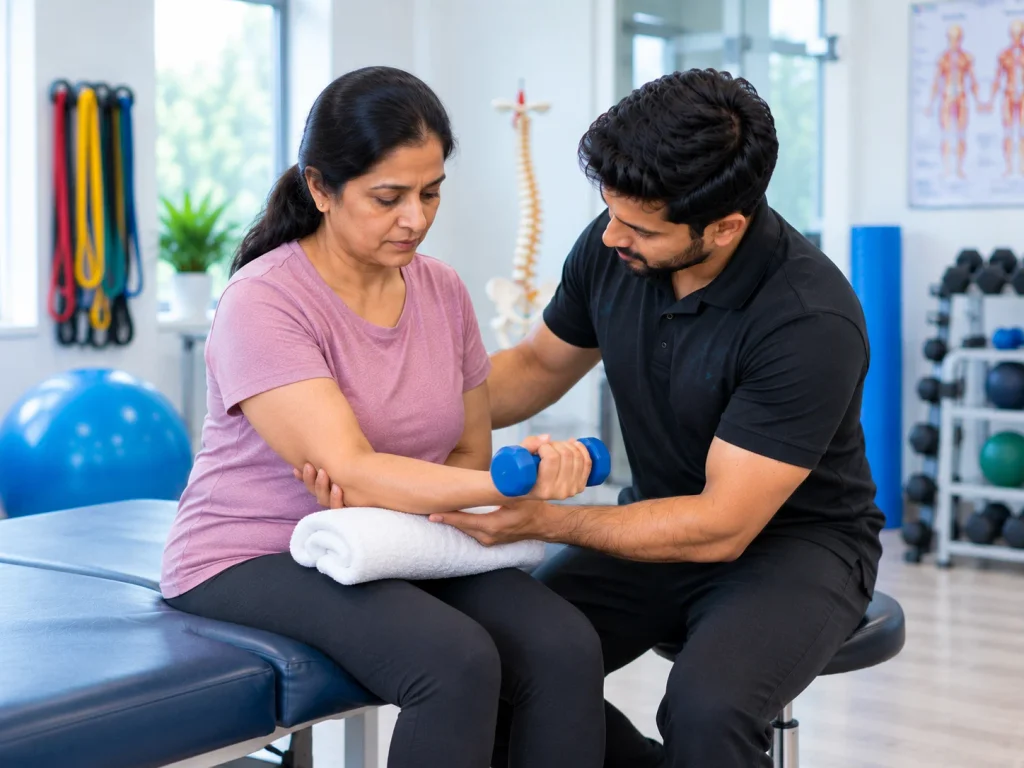
Understanding Mobility & Strength Training and How Mission Walk & Run Supports Recovery
Common Causes of Tennis Elbow
Tennis elbow generally develops when the tissues around the outer elbow are repeatedly exposed to strain. Repetitive loading without adequate recovery can contribute to irritation and reduced tolerance of the affected tissues.
Common contributing factors may include:
- Repeated gripping or lifting
- Frequent wrist extension movements
- Racquet sports or other repetitive sports activities
- Manual work involving tools
- Repetitive computer or desk-related movements
- Sudden increase in exercise or physical workload
- Poor technique during repetitive activities
- Inadequate recovery between demanding activities
The cause and severity can differ between individuals. Understanding the activities that increase symptoms is therefore an important part of planning rehabilitation.
Tennis Elbow Symptoms and Problems
The symptoms of tennis elbow can vary depending on the severity and duration of the condition. Pain is commonly noticed around the outside of the elbow and may increase during activities involving the wrist or hand.
Patients may experience:
- Pain around the outer elbow
- Tenderness near the elbow
- Discomfort while gripping objects
- Pain during lifting or carrying
- Reduced grip strength
- Wrist movement discomfort
- Difficulty performing repetitive tasks
- Increased symptoms after physical activity
Persistent elbow pain can interfere with work, exercise, household activities, and sports. A timely physiotherapy assessment can reveal movement and strength issues and help determine an appropriate rehabilitation approach.
Who Can Benefit From Tennis Elbow Rehabilitation?
Physiotherapy for Tennis Elbow may be useful for people experiencing activity-related elbow pain, reduced grip strength, or difficulty using the affected arm.
Rehabilitation may benefit:
- Recreational and professional sports players
- People involved in repetitive manual work
- Individuals with frequent gripping activities
- Office workers experiencing repetitive arm strain
- People returning to exercise after elbow pain
- Individuals with reduced wrist or forearm strength
The rehabilitation plan should be based on the patient’s symptoms, activity requirements, physical findings, and response to treatment rather than using the same exercise routine for everyone.
Who Can Benefit From Cervical & Neck Pain Physiotherapy?
Cervical and neck pain physiotherapy may be suitable for people experiencing recurring neck discomfort, stiffness, reduced cervical mobility, posture-related problems, muscle tightness, or movement difficulties.
It may also be useful for:
- Office and computer users
- People with prolonged sitting habits
- Individuals experiencing neck and shoulder stiffness
- Patients recovering from certain neck injuries
- People with reduced neck flexibility
- Individuals whose neck discomfort affects everyday activities
Patients with severe, sudden, or unusual symptoms should seek appropriate medical evaluation rather than relying only on self-directed exercises.
Patient Testimonials
See how Mission Walk and Run has made a difference in the lives of our patients
EXCELLENT Based on 9 reviews
 Posted on Google

 Varsha SharmaI had a very good experience at this physiotherapy clinic. The therapist is professional, knowledgeable, and very supportive. They explained the problem clearly and guided me through the exercises and treatment properly. The clinic is clean, well-maintained, and has a positive environment. I would definitely recommend this clinic to anyone looking for effective and professional physiotherapy treatment.Posted on Google
 ranjana kumariI got relief in my knee pain.Posted on Google
 Baliraj SinghGreat 👍 Great work Advance technology used for exercise, Got relief from painPosted on Google
 Mani Bhushanघुटनों के दर्द में बहुत आराम मिला। वहाँ के लोग अच्छी सर्विस दिए।Posted on Google
 reena singhBest physiotherapist in this centre got relief in Frozen shoulderPosted on Google
 Abhijeet KumarBest rehabilitation centre in patnaPosted on Google
 Reetu singh Rajput“It was my first visit to physiotherapy. The physiotherapist listened to my problem patiently and explained the exercises properly. The staff was polite and helpful. Overall, it was a good experience.”Posted on Google
 Ranjan YadavGood 👍🏻Posted on Google
 Pradeep VashisthaBest physiotherapy centre in Patna I got relief in my neck pain thanks to mission walk & run team👍👍
Expert Physiotherapy Care for Tennis Elbow Recovery
Effective tennis elbow physiotherapy focuses on improving elbow and wrist function, forearm strength, grip control, and the ability to perform daily activities comfortably. A structured tennis elbow rehab program is adjusted according to symptoms, physical capacity, and recovery progress.
The rehabilitation approach may focus on:
- Improving elbow and wrist mobility
- Building forearm strength
- Increasing grip strength
- Improving wrist control
- Enhancing forearm flexibility
- Developing muscle endurance
- Improving arm movement coordination
Tennis Elbow Exercises are progressed according to the patient’s pain level, strength, movement ability, and activity demands. The exercise load can be modified as the patient’s tolerance and functional capacity improve.
Modern Physiotherapy Facilities for Effective Tennis Elbow Rehabilitation
A structured rehabilitation environment allows patients to work progressively on mobility, strength, and functional movement. Exercise-based Tennis Elbow Therapy can be adjusted as the patient’s tolerance improves.
Rehabilitation may include:
- Guided therapeutic exercise
- Progressive resistance training
- Wrist and forearm strengthening
- Grip-strength activities
- Mobility exercises
- Functional movement practice
- Gradual return-to-activity training
For patients searching for Elbow Pain Physiotherapy in Patna, assessment-based rehabilitation can help determine which exercises and activity modifications are appropriate for their specific presentation.
Why Choose Mission Walk & Run for Tennis Elbow Rehabilitation?
Effective tennis elbow rehabilitation requires understanding the patient’s pain pattern, grip strength, forearm function, movement restrictions, and daily activity demands. The approach focuses on targeted assessment, progressive exercise, and functional recovery to support a gradual return to routine activities.
Personalised Elbow & Forearm Assessment
A detailed evaluation helps identify elbow and wrist mobility limitations, grip weakness, forearm strength deficits, pain triggers, and functional difficulties affecting everyday activities.
Individualised Rehabilitation Planning
The rehabilitation plan is developed according to the patient’s symptoms, physical findings, activity requirements, recovery progress, and specific functional goals.
Guided Tennis Elbow Exercise Training
Patients receive professional guidance with suitable tennis elbow exercises, wrist and grip strengthening, mobility work, flexibility training, and progressive resistance activities.
Functional Movement & Recovery Support
The rehabilitation approach focuses on improving grip control, forearm strength, wrist coordination, movement tolerance, and the ability to perform work, exercise, or daily activities comfortably.
Ready to take the next step?
Book your physiotherapy session today and start your session journey towards a pain-relief life
Personalised Tennis Elbow Rehabilitation at Mission Walk & Run
Physiotherapy Evaluation for Tennis Elbow at Mission Walk & Run
A detailed evaluation helps determine how elbow pain is affecting movement, strength, grip, and daily activities. The assessment also helps identify movements or activities that may be contributing to symptoms.
The evaluation may include:
- Elbow and wrist movement assessment
- Forearm muscle strength evaluation
- Grip strength assessment
- Pain and tenderness review
- Functional movement assessment
- Activity-related symptom evaluation
- Comparison of movement between both arms
The physiotherapist may also consider the patient’s work requirements, sports participation, exercise routine, previous injuries, symptom duration, and activities that increase discomfort.
Physiotherapy-Based Tennis Elbow Rehabilitation Management
There is no single tennis elbow treatment suitable for every patient. Rehabilitation depends on symptom severity, physical findings, activity demands, and how the elbow responds to exercise.
Management may include:
- Activity modification when certain movements aggravate symptoms
- Mobility exercises for the elbow and wrist
- Progressive forearm strengthening
- Grip-strength training
- Controlled resistance exercises
- Functional movement training
- Gradual return to sports or work-related activities
A tennis elbow physical therapy exercise program is progressed carefully rather than increasing resistance or repetitions too quickly. Patients are guided on appropriate technique and exercise progression to build tolerance without unnecessarily aggravating symptoms.
Benefits of Tennis Elbow Rehabilitation Treatment
A structured rehabilitation program can help patients work toward better arm function and improved tolerance for everyday activities. Progress differs between individuals and depends on factors such as symptom duration, activity demands, consistency, and response to rehabilitation.
Potential benefits include:
- Improved forearm strength
- Better grip capacity
- Improved wrist and elbow movement
- Greater tolerance for daily activities
- Better control during gripping and lifting
- Gradual return to exercise or sports
- Improved confidence using the affected arm
The focus of rehabilitation is to build functional capacity progressively rather than relying only on short-term pain relief.
FAQs About Tennis Elbow Rehabilitation
A suitable rehab program for tennis elbow generally combines activity modification, appropriate mobility exercises, progressive forearm and wrist strengthening, grip training, and gradual return to normal activities. The exact exercises and progression should depend on the patient’s symptoms and physical assessment.
The most appropriate tennis elbow physiotherapy depends on the patient’s condition. Exercise-based rehabilitation commonly focuses on improving forearm strength, grip capacity, wrist control, and tolerance to functional activities. A physiotherapy assessment helps determine which exercises and progression are suitable.
There is no fixed rehabilitation duration for everyone. Recovery can vary depending on how long symptoms have been present, the severity of the problem, activity demands, and response to treatment. Regularly following an appropriate rehabilitation plan can support progressive improvement.
Physiotherapy can help manage tennis elbow by addressing strength, mobility, movement control, and activity tolerance. A structured program may include progressive exercises and guidance on modifying activities that repeatedly aggravate symptoms.
Yes, physiotherapy may help people with tennis elbow by improving forearm strength, grip function, movement control, and tolerance for daily or sporting activities. The treatment plan should be based on individual assessment findings.
A suitable approach depends on the cause, severity, duration, and functional impact of the symptoms. Management may involve activity modification, progressive strengthening, mobility exercises, and physiotherapy. If symptoms persist or do not improve, further medical assessment may be needed.