Stroke
Rehabilitation in Patna, Bihar
A stroke can affect movement, strength, balance, coordination, speech, and daily activities. Depending on the brain area involved, patients may experience one-sided weakness, walking difficulties, reduced hand control, stiffness, or problems with routine tasks. Recovery varies from person to person, making individualised rehabilitation important.
Stroke Rehabilitation in Patna focuses on restoring functional abilities through structured physiotherapy. At Mission Walk & Run, Physio Ortho Neuro Rehab Centre in Rajeev Nagar, Patna, programs are tailored to mobility, muscle control, balance, coordination, and recovery progress. Treatment may include gait training, strengthening, mobility exercises, balance work, and functional activities. Dr. Manish Kumar, with 6 years of experience and 10,000+ patients treated, supports an assessment-based and progressive rehabilitation approach.
Understanding Stroke Rehabilitation and How Mission Walk & Run Supports Recovery
Common Causes and Effects Associated With Stroke Rehabilitation
A stroke can affect the brain when its blood supply is blocked or a blood vessel bleeds. The resulting difficulties depend on the brain region involved and the extent of neurological damage.
After a stroke, patients may experience:
- Weakness or reduced control on one side
- Difficulty standing or walking
- Poor balance and coordination
- Reduced hand and arm function
- Muscle stiffness or altered muscle tone
- Difficulty performing daily activities
- Reduced confidence during movement
These difficulties can change over time. Rehabilitation therefore needs to be regularly reviewed and adapted as the patient’s abilities develop.
Symptoms and Problems Associated With Stroke Recovery
Stroke-related movement problems can affect both physical independence and participation in everyday activities. A patient may be able to perform a movement in one situation but struggle when the same movement is required during a practical task.
Common rehabilitation challenges include:
- Difficulty getting up from a chair
- Reduced walking speed or stability
- Difficulty climbing stairs
- Trouble reaching or grasping objects
- Reduced control of the affected hand
- Difficulty maintaining standing balance
- Problems with coordinated movements
- Dependence on assistance for routine activities
The rehabilitation process focuses on practical abilities rather than concentrating only on isolated muscle movements. Functional tasks can be incorporated according to the patient’s current capacity.
Who Can Benefit From Stroke Rehabilitation?
Stroke rehabilitation physiotherapy may benefit patients experiencing movement, balance, strength, or functional difficulties following a stroke. Rehabilitation requirements can differ significantly between patients, even when their medical diagnosis is similar.
Support may be appropriate for:
- Patients in the early stages of stroke recovery
- Individuals with persistent weakness after stroke
- Patients having difficulty walking independently
- People experiencing balance or coordination problems
- Individuals with reduced arm or hand function
- Patients working toward greater independence in daily activities
The rehabilitation plan should be based on professional assessment and the patient’s current abilities rather than applying a fixed exercise routine.
Who Can Benefit From Cervical & Neck Pain Physiotherapy?
Cervical and neck pain physiotherapy may be suitable for people experiencing recurring neck discomfort, stiffness, reduced cervical mobility, posture-related problems, muscle tightness, or movement difficulties.
It may also be useful for:
- Office and computer users
- People with prolonged sitting habits
- Individuals experiencing neck and shoulder stiffness
- Patients recovering from certain neck injuries
- People with reduced neck flexibility
- Individuals whose neck discomfort affects everyday activities
Patients with severe, sudden, or unusual symptoms should seek appropriate medical evaluation rather than relying only on self-directed exercises.
Patient Testimonials
See how Mission Walk and Run has made a difference in the lives of our patients
EXCELLENT Based on 9 reviews
 Posted on Google

 Varsha SharmaI had a very good experience at this physiotherapy clinic. The therapist is professional, knowledgeable, and very supportive. They explained the problem clearly and guided me through the exercises and treatment properly. The clinic is clean, well-maintained, and has a positive environment. I would definitely recommend this clinic to anyone looking for effective and professional physiotherapy treatment.Posted on Google
 ranjana kumariI got relief in my knee pain.Posted on Google
 Baliraj SinghGreat 👍 Great work Advance technology used for exercise, Got relief from painPosted on Google
 Mani Bhushanघुटनों के दर्द में बहुत आराम मिला। वहाँ के लोग अच्छी सर्विस दिए।Posted on Google
 reena singhBest physiotherapist in this centre got relief in Frozen shoulderPosted on Google
 Abhijeet KumarBest rehabilitation centre in patnaPosted on Google
 Reetu singh Rajput“It was my first visit to physiotherapy. The physiotherapist listened to my problem patiently and explained the exercises properly. The staff was polite and helpful. Overall, it was a good experience.”Posted on Google
 Ranjan YadavGood 👍🏻Posted on Google
 Pradeep VashisthaBest physiotherapy centre in Patna I got relief in my neck pain thanks to mission walk & run team👍👍
Expert Physiotherapy Care for Stroke Recovery
Stroke recovery often involves repeated practice of purposeful movements. A structured Stroke Recovery Physiotherapy program focuses on improving the physical abilities needed for everyday tasks while accounting for the patient’s neurological condition and current functional limitations.
Rehabilitation may focus on:
- Improving sitting and standing control
- Enhancing walking ability
- Rebuilding muscle strength
- Improving balance and coordination
- Developing arm and hand function
- Practising everyday functional activities
- Improving movement control
- Supporting greater independence
Exercises are adjusted according to the patient’s abilities, response, and stage of recovery. The rehabilitation approach aims to provide an appropriate level of challenge while addressing the specific functional needs of each patient.
Modern Physiotherapy Facilities for Stroke Rehabilitation
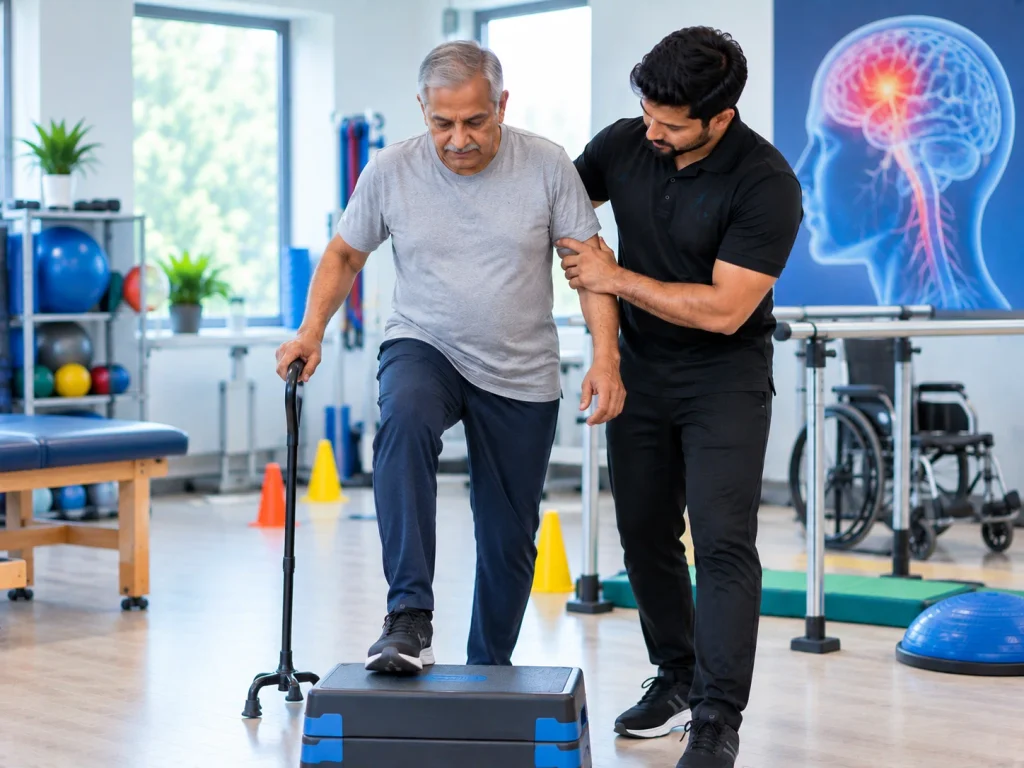
Stroke rehabilitation often requires repeated practice of movement, balance, walking, and functional activities. A dedicated rehabilitation environment allows these skills to be practised with appropriate guidance and progression.
The rehabilitation program may include:
- Gait and walking training
- Balance and stability practice
- Functional movement exercises
- Upper-limb rehabilitation
- Hand and grip activities
- Strength and mobility exercises
- Task-specific movement training
- Progressive exercise programs
The rehabilitation setup supports a progressive approach in which exercises and functional activities can be adjusted to the patient’s abilities and recovery stage. The aim is to encourage safer movement, improve functional independence, and support gradual progress throughout stroke rehabilitation.
Why Choose Mission Walk & Run for Stroke Rehabilitation?
Effective stroke rehabilitation requires understanding how the condition has affected the patient’s movement, strength, balance, coordination, and everyday independence. A personalised approach helps address these challenges through structured rehabilitation and progressive functional training.
Personalised Neurological Assessment
A detailed evaluation identifies movement limitations, muscle weakness, balance difficulties, coordination problems, walking challenges, and changes in upper-limb or hand function that may affect daily activities.
Individualised Stroke Rehabilitation Planning
The rehabilitation plan is tailored to the patient’s current abilities, neurological limitations, mobility level, recovery stage, and specific functional goals, with progression adjusted as recovery develops.
Guided Stroke Recovery Training
Patients receive professional guidance through gait and walking practice, balance training, strengthening exercises, mobility activities, and upper-limb rehabilitation based on their individual requirements.
Functional Recovery & Independence Support
The rehabilitation approach focuses on improving movement control, walking ability, balance, strength, coordination, and practical skills needed to perform everyday activities with greater independence.
Ready to take the next step?
Book your physiotherapy session today and start your session journey towards a pain-relief life
Personalised Stroke Rehabilitation at Mission Walk & Run
Physiotherapy Evaluation for Stroke Rehabilitation
A detailed evaluation helps understand the patient’s current physical abilities and the difficulties affecting daily movement. The assessment provides information needed to establish practical rehabilitation goals.
The evaluation may include:
- Muscle strength assessment
- Joint movement review
- Sitting and standing balance
- Walking and gait assessment
- Coordination testing
- Functional mobility assessment
- Upper-limb and hand function
- Ability to perform daily activities
The physiotherapist may also consider the patient’s stroke history, previous rehabilitation, current activity level, assistance requirements, and progress since the event.
Physiotherapy-Based Stroke Rehabilitation Management
There is no single stroke recovery treatment that works in exactly the same way for every patient. Rehabilitation depends on the neurological effects of the stroke, physical abilities, medical considerations, and functional goals.
Post Stroke Physiotherapy may involve:
- Movement retraining
- Walking and gait practice
- Balance exercises
- Strengthening activities
- Mobility exercises
- Upper-limb rehabilitation
- Hand function training
- Functional task practice
Post stroke hand rehabilitation may focus on controlled arm movements, reaching, grasping, releasing, and other practical tasks when appropriate. Similarly, patients with walking difficulties may work on standing control, weight shifting, stepping, gait pattern, and balance.
Benefits of Stroke Rehabilitation Treatment
A structured rehabilitation program can help patients work toward better movement and greater participation in everyday activities. The extent and speed of recovery vary considerably between individuals.
Potential rehabilitation goals may include:
- Better sitting and standing control
- Improved walking ability
- Increased strength and mobility
- Improved balance and coordination
- Better hand and arm function
- Greater participation in daily activities
- Increased confidence during movement
- Improved functional independence
The purpose of rehab for stroke recovery is not simply to perform exercises but to help patients practise useful movements that relate to their individual goals and daily life.
FAQs About Stroke Rehabilitation
Stroke recovery does not follow a universal timeline or guaranteed quick method. Improvement can depend on the nature of the stroke, neurological involvement, general health, and the patient’s rehabilitation requirements. At Mission Walk & Run, Physio Ortho Neuro Rehab Centre in Rajeev Nagar, Patna, therapy is structured around the patient’s functional difficulties and current recovery level. Dr. Manish Kumar, with 6 years of physiotherapy experience and 10,000+ patients treated, follows a progressive, assessment-led rehabilitation approach.
Exercise selection should be based on what the patient can safely perform and the limitations identified during assessment. At Mission Walk & Run, rehabilitation may address walking, balance, strength, mobility, coordination, and arm or hand function through individually selected activities. Dr. Manish Kumar guides the exercise plan according to the patient’s abilities, response to therapy, and functional objectives.
There is no identical physiotherapy routine for every stroke patient. Depending on individual difficulties, rehabilitation at Mission Walk & Run may incorporate walking practice, balance work, strengthening, mobility training, upper-limb exercises, and everyday task practice. The program is modified as the patient’s functional capacity changes.
The outcome of stroke rehabilitation varies considerably between individuals. Some people may regain substantial function, while others may continue to experience movement or coordination difficulties. At Mission Walk & Run, the focus is on helping each patient improve achievable areas such as mobility, balance, strength, coordination, and daily function. Dr. Manish Kumar develops rehabilitation according to individual assessment rather than promising a specific recovery outcome.
The early period after stroke is important because timely medical management and rehabilitation can help address functional problems. However, rehabilitation is not limited to one short window. Patients can continue working on functional abilities beyond the early recovery period according to their needs and medical condition.
Exercise may be appropriate for many stroke patients when it is selected according to their medical status and physical capabilities. At Mission Walk & Run, activities can be chosen around factors such as muscle control, balance, mobility, coordination, and current functional ability. Dr. Manish Kumar can guide exercise selection and progression so that the rehabilitation program matches the patient’s individual requirements.